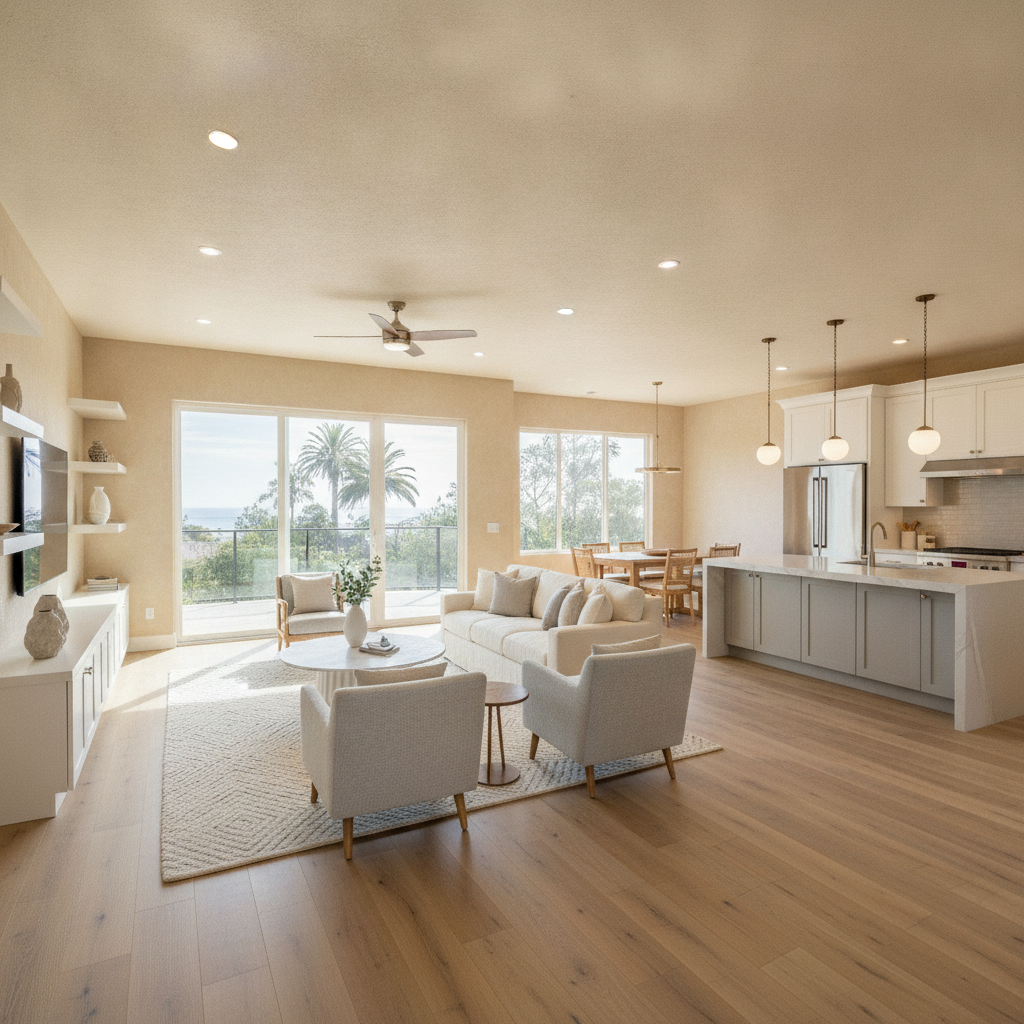
San Clemente kitchens work harder than kitchens ten miles inland, and they wear out differently. The same salt air that makes an evening on Avenida Del Mar worth the drive also corrodes hinges, pits faucet finishes, swells cheap cabinet boxes, and rusts appliance trim years before it would fail in Mission Viejo or Rancho Santa Margarita. So when homeowners here ask what a kitchen remodel costs, the honest answer has two parts: the normal South Orange County price for the scope you want, and the coastal decisions that keep you from paying for that remodel twice.
This guide breaks down typical kitchen remodel cost ranges in San Clemente for 2026, what drives the number up or down, which materials actually hold up within a mile or two of the water, and how permits and HOAs work in neighborhoods from Talega to the Pier Bowl. These are typical ranges based on current local labor and material costs — they are ranges, not quotes. Your kitchen gets a real number only after someone measures it, opens nothing up on a guess, and prices the exact scope in writing.
The Short Answer: Typical Ranges in San Clemente
For a standard San Clemente kitchen — roughly 120 to 200 square feet, keeping the same general footprint — most projects we see fall into three bands:
- Cosmetic refresh: $25,000–$45,000 (typical range). Cabinet refacing or repainting with new doors, new quartz or quartzite counters, a tile backsplash, new sink and faucet, new lighting, and paint. No walls move, no plumbing or electrical relocates, appliances stay in place or swap like-for-like.
- Mid-range remodel: $55,000–$95,000 (typical range). New semi-custom cabinets, quartz counters, full tile backsplash, under-cabinet lighting, new appliances, LVP or engineered wood floors tied into the adjoining room, and modest electrical updates to bring receptacle spacing and GFCI protection up to current code.
- High-end remodel: $110,000–$200,000+ (typical range). Custom cabinets, walls removed for an open plan (with engineered beams and structural permits), relocated plumbing and gas, panel-ready appliances, natural stone or high-end quartzite, wide-plank white oak, and a layout built around how the house actually lives — surf gear rinsed out back, kids at the island, doors open to the patio half the year.
Layout changes are the single biggest cost lever. Keeping sink, range, and refrigerator roughly where they are can save $8,000–$20,000 compared with a full relocation, because you are not paying for new drain, water, gas, and vent runs through a slab or a second-story floor.
For a nearby comparison, see our Dana Point kitchen cost guide.
Why San Clemente Kitchens Cost What They Cost
San Clemente’s housing stock is a mix that matters for pricing. You have 1920s and 1930s Spanish Revival homes in the Pier Bowl and around Avenida Victoria — small kitchens, plaster walls, old galvanized or cast-iron drains, and electrical panels that were never sized for a modern induction range and a double oven. You have mid-century and 1970s tract homes in neighborhoods like Rancho San Clemente, where kitchens are bigger but plumbing and wiring are at the age where a remodel finds surprises. And you have Talega and Forster Ranch — newer, HOA-governed homes from the 2000s where the bones are modern but the builder-grade cabinets and counters are now 20 years old and tired.
Each stock type carries its own line items:
- Older Pier Bowl and Southwest San Clemente homes: Budget for electrical panel evaluation early. Adding a 50-amp induction circuit, dedicated small-appliance circuits, and code-required GFCI/AFCI protection to a 100-amp panel sometimes means a panel upgrade, which is a separate permit and a typical range of $2,500–$5,000. Old drain lines scoped with a camera before demo save arguments later.
- Tract homes from the 1960s–1980s: Watch for aluminum wiring in some eras, asbestos-containing materials in old flooring mastic and pipe insulation (testing is cheap; guessing is not), and out-of-flat slabs that need prep before large-format tile or LVP lays right.
- Talega and Forster Ranch: The structure is rarely the problem. The budget questions are HOA architectural review for any exterior change (windows, vents, a new door to the side yard), work-hour rules, and matching community standards if your remodel touches anything visible from the street. Interior-only kitchen work usually needs no HOA approval, but confirm before you assume — Talega’s master association and sub-associations do not all draw the line in the same place.
Salt Air: The Material Choices That Actually Matter
This is the section most inland remodel guides skip, and it is the one that decides whether your San Clemente kitchen still looks good in ten years.
- Cabinet hardware and hinges. Within roughly a mile of the coast, cheap zinc hardware and standard steel hinges corrode — first a dull film, then pitting, then seized soft-close mechanisms. Specify stainless steel or solid brass hardware, and ask your cabinet supplier specifically about hinge and drawer-slide finishes rated for coastal use. The upgrade is a few hundred dollars on a mid-range kitchen. Replacing every hinge and pull in eight years costs far more.
- Faucets and fixtures. Polished chrome and stainless finishes hold up best in salt air. Unlacquered brass will patina fast near the water — some homeowners love that look, but choose it on purpose, not by accident. Matte black finishes from budget brands are the most common early failure we see near the coast; the coating chalks and flakes. If you want matte black, buy it from a manufacturer that warranties the finish, and keep the receipt.
- Appliances. Stainless appliance panels are not all equal. Lower-grade stainless rusts at the edges in coastal homes, especially on dishwashers and refrigerator doors closest to an open slider. Several manufacturers offer coastal or marine-grade guidance — at minimum, plan on wiping exterior stainless with a protectant a few times a year, and keep the slider weatherstripping in good shape so salt air is not pouring in all summer. Panel-ready appliances hide the issue entirely and are one reason they show up in so many high-end coastal remodels.
- Cabinets themselves. Plywood boxes outlast particleboard and MDF boxes in humid coastal air, full stop. MDF doors with a quality painted finish are fine — they actually paint smoother than wood — but sink-base cabinets should be plywood or, better, a synthetic sink base, because the one leak every kitchen eventually has will destroy a particleboard sink cabinet and merely embarrass a plywood one.
- Ventilation. A real vent hood ducted outside matters more here than inland. San Clemente homes sit open half the year, and cooking moisture plus ocean humidity is a mold recipe in closed cabinets and wall cavities. Budget for proper ducting in the remodel rather than a recirculating hood that just moves greasy air around.
Permits in the City of San Clemente
Interior kitchen remodels in San Clemente go through the City’s Building Safety division. The practical rules:
- Like-for-like cosmetic work — paint, refacing, counters on existing cabinets — generally needs no building permit, though electrical and plumbing changes always do.
- Any project that moves walls, relocates plumbing or gas, adds circuits, or changes windows and doors needs permits, plan submittal, and inspections. Structural changes like removing a load-bearing wall for an open plan need engineered drawings and a structural permit.
- Permit fees for a typical mid-range kitchen remodel are usually a small percentage of the total budget — plan on a typical range of $800–$2,500 for city fees depending on scope and valuation, plus engineering if you are moving structure.
- Timelines: a straightforward kitchen permit in San Clemente is commonly issued in a few weeks; structural submittals take longer. Build that into your schedule before demo is promised for a date.
- Final inspection and a signed-off permit card matter at resale. Unpermitted kitchen work is one of the most common disclosure fights in San Clemente home sales, especially in the Pier Bowl where remodels are frequent and buyers are paying coastal prices.
If your home is in an HOA — Talega, Forster Ranch, Rancho San Clemente, and many condo communities — check architectural guidelines before finalizing any plan that changes exterior venting, windows, or doors. Interior-only work is usually exempt, but the confirmation takes one email and saves a stop-work headache.
A Week-by-Week Sense of the Process
A mid-range San Clemente kitchen remodel with no layout change typically runs five to eight weeks of on-site work once materials are on hand. Cosmetic refreshes can finish in two to four weeks. High-end projects with structural work run ten to sixteen weeks, and the calendar is usually decided less by the work itself than by cabinet lead times and inspection scheduling.
The order that keeps a job clean: design and selections locked before demo, cabinets ordered and confirmed before anything is torn out, demo, rough plumbing and electrical with inspection, drywall and paint, cabinets, counters templated after cabinets are set (allow about two weeks for fabrication), tile, floors, appliance install, final plumbing and electrical trim, final inspection, and a punch walk. Homeowners who pick tile, counters, and fixtures during week three instead of week zero are the number-one cause of the two-week gap in the middle of a remodel where nothing seems to happen.
If you are also planning a bathroom, see our bathroom remodel timeline in Laguna Niguel for a sense of how that process runs.
Where Homeowners Overspend — and Where They Shouldn’t Cut
Overspends we see in San Clemente: exotic stone that needs annual sealing a block from the beach (quartzite and quartz usually serve coastal families better), appliance packages bought for badge value in a kitchen that cooks twice a week, and custom cabinets in a cosmetic-scope project where semi-custom would look identical.
Cuts that come back to bite: skipping the vent ducting, particleboard sink bases, budget matte-black fixtures near the coast, and — the big one — hiring on the lowest bid without a written scope. California law (Business & Professions Code §7159) requires home improvement contracts over $500 to be in writing with specific terms, and limits the down payment to $1,000 or 10% of the contract price, whichever is less. Any contractor who asks for half up front on a San Clemente kitchen is asking you to break the pattern the law set for your protection.
Frequently Asked Questions
How much does a kitchen remodel cost in San Clemente in 2026?
Most typical projects fall in these ranges: $25,000–$45,000 for a cosmetic refresh, $55,000–$95,000 for a mid-range remodel with new cabinets, and $110,000–$200,000 or more for high-end work with layout changes. These are typical ranges, not quotes — layout changes, structure, and selections move the number most.
Does salt air really damage a kitchen?
Yes, within roughly a mile of the water it is a real factor. It corrodes hinges, hardware, faucet finishes, and lower-grade stainless appliances years faster than inland. Stainless or solid-brass hardware, plywood cabinet boxes, quality faucet finishes, and a properly ducted vent hood are the main defenses, and together they add very little to a remodel budget.
Do I need a permit for a kitchen remodel in San Clemente?
Cosmetic work like paint, refacing, and counters usually does not. Moving walls, relocating plumbing, gas, or electrical, or changing windows and doors does, through the City of San Clemente Building Safety division. Structural wall removal needs engineered plans as well.
Does Talega or Forster Ranch HOA need to approve my kitchen remodel?
Interior-only work usually does not need HOA approval, but any change visible from outside — windows, doors, exterior vents — generally needs architectural review first. Each sub-association draws the line slightly differently, so confirm in writing before you start.
How long will my kitchen be out of service?
Plan on two to four weeks for a cosmetic refresh, five to eight weeks for a mid-range remodel, and ten to sixteen weeks for high-end work with structural changes, once materials are on hand. A temporary setup — microwave, electric kettle, and a folding table — gets most families through it without eating out every night.
What down payment can a contractor legally ask for in California?
For home improvement contracts, California limits the down payment to $1,000 or 10% of the contract price, whichever is less. Payments after that should track progress on a written schedule in your contract.
Talk Through Your San Clemente Kitchen
If you are pricing a kitchen remodel in San Clemente, Dana Point, San Juan Capistrano, or anywhere in South Orange County, Timberline Build Co. will walk the kitchen with you, talk honestly about which band your scope falls in, and put the number in writing — including the coastal material choices that keep it looking right. Call Timberline Build Co. at (949) 229-1692 to schedule a walkthrough.